Terrestrial By Suzy Eynon (released May 19, 2026)
do you believe we are alone

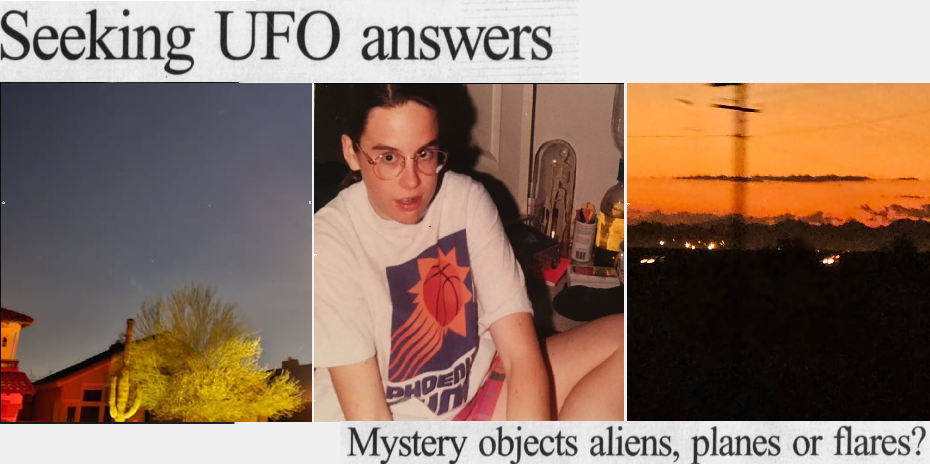
Terrestrial by Suzy Eynon. Literary Fiction Paperback. 90 pgs.
ISBN 13 9781968523107
ISBN 10 1968523103
SOLD OUT. Copies available from Asterism.
Terrestrial tells the story of a young girl, Daisy, who lives in the humdrum world of suburban high school life and crafts one of her own design. That description alone would have you think this is a young adult novel. But this isn’t YA, this is literary magic, science fiction, secrecy, and conspiracies (or is it?) written in a style of psychological poetry.
The story begins with Daisy hiding in the bathroom only to discover a note attached to the door with bubble gum: do you believe we’re alone. She loves adventure films and like the boys in her favorite cinematic masterpieces, she goes on her own quest to find who left the mysterious correspondence. Was it her romantic interest, Steven? Her sister? Some unseen boogeyman?
At a bookstore she runs across a copy of Unexplained Phenomena, which in my head is similar to Mysteries of the Unexplained. There is an entry about UFOs and an event that happened 50 years prior near where she lives proving an impeccable intuition on her part. The story’s peak leads to a very surprising moment and ends with a figurative answer to the note.
Like most teens, Daisy feels like an outsider, but we imagine Daisy is the misfit’s misfit--an anxious introvert who is very astute, smart, and fiercely independent of mind. Her life with her family, especially her sister, is a bit strained.
Her relationships with boys are complex, which I, without being a woman attracted to men, somehow understand. And the reason why is that the gift of Terrestrial is I had the opportunity to empathize and put myself in Daisy shoes.
Eynon throws you into her protagonist’s world first hand so that you know what it means to be an anxious teenage girl in a world that feels alien to you. I understood what Daisy meant when she said she was often both attracted to and strongly empathized, if not outright identified with characters who were the opposite sex.
In her mind, she sees herself not as herself but as a boy. When she watches movies with them as protagonists, including her favorite Three Ninjas (did I watch this film for the first time to understand the reference? You bet your sweet ass I did), she sees herself as both a boy and someone who wants to hang out in Rocky’s amorous company.
While Daisy watched The Lost Boys and Three Ninjas, I used to come home every single day and watch Heathers. I started smoking so that I could be cool enough to hang out with Veronica Sawyer. And while girls at school identified me with JD, I always strongly identified with Veronica. But while I understood the exterior of Veronica’s life, so much was not given to me in the one hour and forty-three minute film.
I read the entire Babysitters Club series, even though I was a boy, and it turned out that I related to it heavily as an older sibling, but I was lost when it came to understanding girls. I loved the weird girls in Greek mythology, Persephone, Athena, Cassandra, etc more than I ever did the heroes, but they were nearly all tragic.
Sure, there were literature books, but I avoided literature because it was for rich people. It wasn’t until I read Go Ask Alice, or about Elise in Mary Gaitskill’s Because They Wanted to that I read anything about the terror of being a teenage girl.
I believe the science that says reading can improve a person’s empathy and the way they look at the world. Not just me, but Daisy’s background in these adventure movies (she’s also a fan of Huckleberry Finn and Jim Carroll’s The Basketball Diaries) informs how she sees the world and how she navigates it. She is brave, inquisitive, despite coming off shy in the company of her peers. She is a perfect heroine.
Reading Eynon’s depiction of teenage girlhood offers me insight into at least one teenage girl’s life and I will appreciate in perpetuity. I can’t help but notice that in Suzy Enyon’s Instagram post announcing the books release, she has a picture (I asked permission to use it) of herself in a Phoenix Sun’s jersey with braces (which is how Daisy looks) as if to impart, that not only are we getting an opportunity to see inside the mind of the novelist, but the author isn’t too far removed from Daisy. And this is truly important to me.
Suzy Eynon is an important flash fiction writer and editor. Having published widely and edited for Variant, Five South, and JMWW, she is a literary citizen extraordinaire. She’s published in places I can only dream about. She’s one of my favorite people in the universe and if you read her work you will know why.
I don’t know how much of Eynon is Daisy, but I do know this: I will treasure this novella forever. I’ve read it multiple times and sometimes out loud so I can hear Eynon’s words roll off my tongue and swim into the air. I love reading passages from this book with my voice, every breath acting as a small prayer before I recite the glorious internal rhythm of Daisy’s consciousness as articulated by Eynon. Somehow even the most mundane moments are precious. Even the moments we’re reading about her struggle with counting calories because the descriptions are so vivid. And as weird and fanciful and moonbatty as all that sounds, it’s that way, because life as a teenage girl really is that hard and we are blessed that Eynon wrote it down for us. And I know that Daisy is just a character, but Eynon makes you care so much that you want Daisy to know that she is way cooler and more special than she knows.